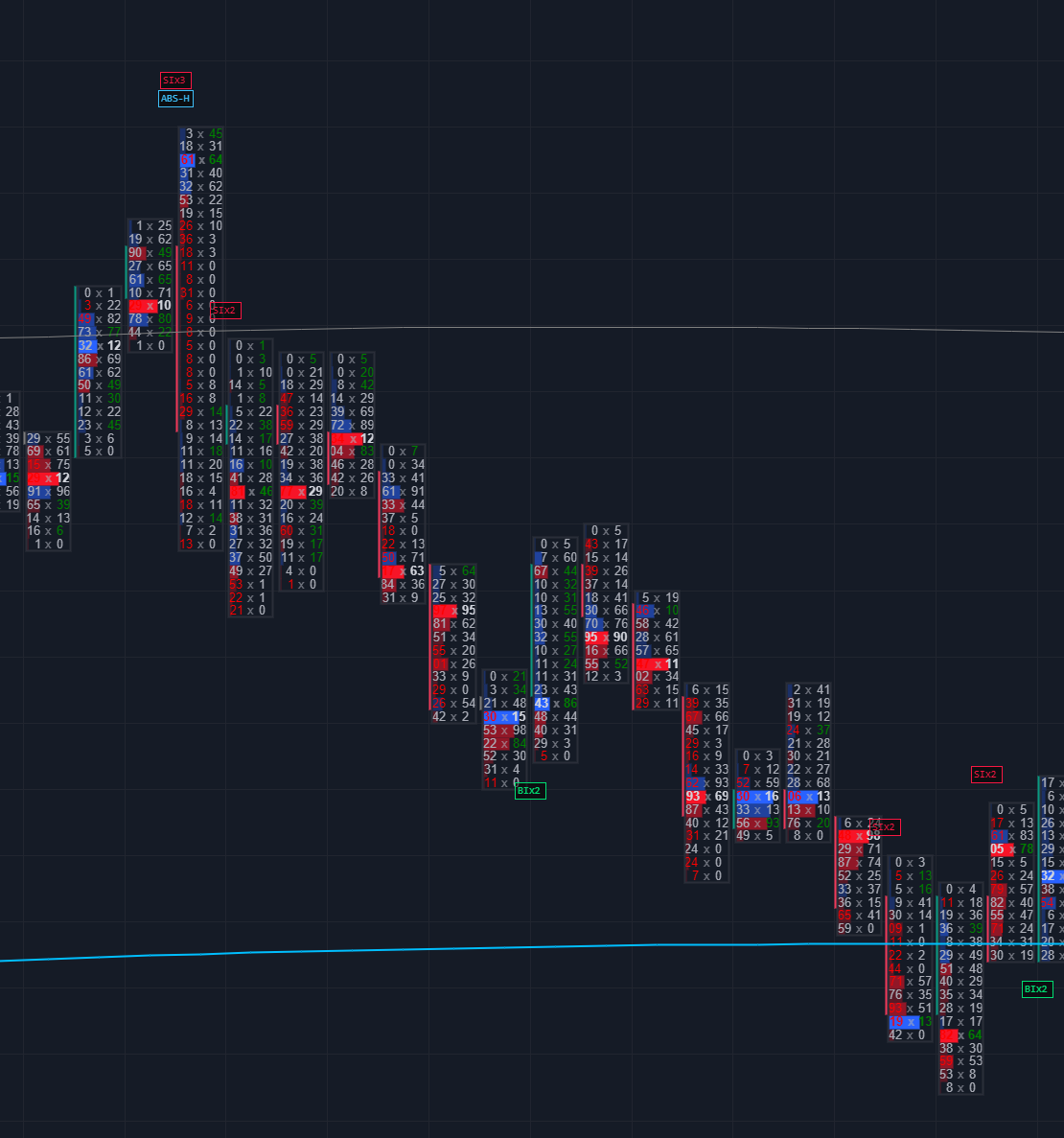
What is a bid/ask imbalance?
An imbalance exists when ask volume at a price level significantly exceeds bid volume on the level below (buy imbalance) or the reverse for sell imbalance. It shows one-sided aggression at specific prices — a footprint of directional intent.
Why stacked imbalances matter (BIx2, BIx3, SIx2, SIx3)
A single imbalance can be noise. Stacked imbalances (two or more consecutive levels meeting ratio and volume thresholds) suggest sustained one-sided flow — higher conviction. XtradeReverse labels these as BIx/SIx with stack depth in the marker text.
How to read the markers on the chart
Markers plot on bars where the C1–C5 pattern is evaluated. Long-bias setups look for buy imbalances (BIx); short-bias setups look for sell imbalances (SIx). Combine with ABS markers: absorption + imbalance in the same direction is a strong confluence.
Combining imbalance with absorption
Ideal reversal context: price tests an extreme, ABS-L or ABS-H shows failed continuation, then BIx/SIx confirms aggressive flow in the reversal direction on the trigger bar. XtradeReverse encodes this logic in the footprint filter pipeline automatically.
Configuration: Imbalance Ratio %, Stack Levels
- Imbalance Ratio % — minimum ask:bid (or bid:ask) ratio to count a level as imbalanced
- Min Imbalance Volume — filters out thin levels
- Stacked Imbalance Levels — how many consecutive levels must qualify (e.g. 2 or 3)